 Login
Login


 Products


 Go Back to blog listing page
Land loan vs. Home Loan: Which is better?



June 27, 2024
1 min
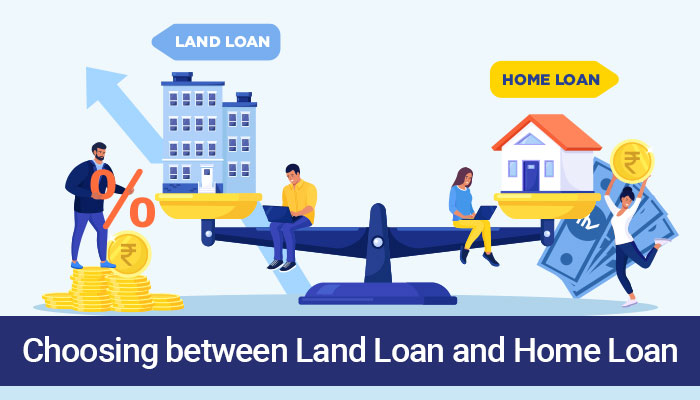
Potential purchasers in the real estate investment space frequently have to choose between taking out a home loan to purchase an existing property or a land loan to buy a plot of land for future building. The best financing choice will vary depending on personal objectives, financial circumstances, and long-term intentions.
Each financing option has advantages and disadvantages of its own. To assist you in selecting which option could be more appropriate for your needs, this article will examine the main distinctions between Land vs Home Loan.
Understanding Land Loans
A land loan is a type of loan used to buy land when there isn't a clear plan to build a house immediately. These loans are frequently utilised for agriculture, future construction projects or speculative investments.
Various Land Loan Types
- Raw Land Loan: For undeveloped land lacking infrastructure or utilities. These loans have more stringent conditions and are regarded as high-risk.
- Improved Land Loan: For properties with access to essential utilities, including electricity, water and roads. Though less dangerous than raw land loans, they must be carefully considered.
Benefits of Land Loan
- Flexibility: Purchasing land allows you to develop the area however you see fit or construct the house of your dreams.
- Investment Potential: Land, particularly in high-growth regions, can gain significantly over time.
- Lower Initial Cost: Purchasing land may be less expensive upfront than buying a pre-built home.
Drawbacks of Land Loans
- Higher Interest Rates: Because undeveloped land carries a greater risk, land loan interest rates are sometimes higher.
- Shorter Loan Tenures: Because of their shorter payback terms, the monthly payment amounts for these loans are usually higher.
- Tighter Requirements: Lenders may have more stringent qualifying requirements and demand a larger down payment.
Understanding Home Loans
A mortgage, often known as a home loan, is a loan obtained to buy a residential property that has already been built. Buying pre-occupied or newly constructed homes is a common application for home loans.
Home Loan Types:
- Fixed-Rate Mortgage: A fixed-rate mortgage offers consistent monthly payments over the loan term at a fixed interest rate.
- Adjustable-Rate Mortgage (ARM): An adjustable-rate mortgage (ARM) may have lower initial payments, but possible future rises because the interest rate is subject to periodic adjustments based on market conditions.
Advantages of Home Loan Mortgages
- Reduced Interest Rates: Because a built-up property carries less risk, home loans often have lower interest rates than land loans.
- Longer Tenures: These loans' monthly payments can be lowered by spreading them out over longer time frames, often as long as 30 years.
- Tax Benefits: Home loan interest can frequently be written off as a tax deduction for borrowers, which has positive financial effects.
Drawbacks of Home Loans
- Less Flexibility: Compared to building on purchased land, purchasing an existing home gives you less freedom to customize and design it how you want.
- Greater Initial Investment: Buying a home requires a more significant initial investment, including the down payment and closing costs.
Factors to Consider: Home Loan vs. Land Loan
Following are the factors to be considered when confused between home or land loan -
- Objectives & Goals:
- Future Construction or Investment: A land loan can be a better choice if you want to hold land as an investment or construct your ideal home to precise specifications.
- Immediate Residence: If you need a place to live immediately, getting a house loan to buy an existing property is a better option.
- Economic Circumstances:
- Upfront Costs: Consider your capacity to pay a larger down payment and manage a land loan's shorter term.
- Monthly Budget: Assess your capacity to oversee instalments regularly. Home loans, with their longer terms and lower interest rates, can reduce monthly financial difficulties.
- Tolerance for Risk:
- Market Volatility: Owing to the possibility of infrastructural development in the area and the fluctuating nature of the market, investing in land can be riskier.
- Stable Asset: A home loan offers a more stable and immediate asset by limiting exposure to the market risks associated with undeveloped land.
In Summary
Each type of loan — plot loan vs. home loan — has advantages and disadvantages. Your decision should be based on your risk tolerance, financial capabilities and long-term objectives. A plot loan can be a better option if your top priorities are future development and flexibility.
On the other hand, a home loan can be more beneficial if you're looking for a quick dwelling and stable finances. Take the time to carefully consider your needs and speak with financial professionals so that you may make the most excellent choice for your unique situation. Visit IIFL Home Loans for information on the best home loan interest rates.
Tags

Most Read Blogs





Frequently Asked Questions (FAQ’s)
Q1. Can I receive a full home loan?
Ans:
Safety issues are a factor. Lenders will not approve a 100% loan for a mortgage. You can borrow up to 80% of the property's current market value from a lender.
Q2. Are loans for land and houses the same thing?
Ans:
While land loans are available for buying a parcel of land to build a house on or as an investment, home loans are accessible for properties that are under construction, ready to move into, or expected to be constructed shortly.
Q3. Can a land loan be converted into a house loan?
Ans:
Once the building is finished, you can give your lender the certificates of completion and occupation to convert your land loan into a house loan.
Q4. What income level is required to be eligible for a mortgage?
Ans:
Applying for a home loan with a consistent monthly salary of between Rs. 25,000 and Rs. 30,000 is generally advised, though there may be variations in minimum wage requirements.
Q5. Who needs to be qualified for a mortgage?
Ans:
If you plan to retire soon, you might not be able to get a house loan because you would need a longer time to pay it back. If the lender thinks you will have enough income to repay the loan before you retire, they may still consider lending you money for a house.
What can we help you with?

Home Loan

Secured Business Loan

Balance Transfer

Home Improvement Loan

Home Loan for Uniformed Services

NRI Home Loan
Home Loan
Secured Business Loan
Balance Transfer
Home Improvement Loan
Home Loan for Uniformed Services
Get instant support with existing loan related queries

Raise a Request Get instant access to your existing Loan Account with us Raise a Ticket 

Call Helpline Speak with our Customer Support Executive on 1860 267 3000

Visit Nearby Branch You can walk into any of our 300+ branches, spanning across 18 states Get Directions
Our Brands & Subsidiaries


Insurance Partners


HDFC Life Insurance
Learn more
Bajaj Life Insurance
Learn more
ICICI Prudential Life Insurance
Learn more
Go Digit General Insurance
Learn more
Aditya Birla Capital Insurance
Learn more
Bajaj Allianz General Insurance
Learn more


