 Login
Login


 Products


 Go Back to blog listing page
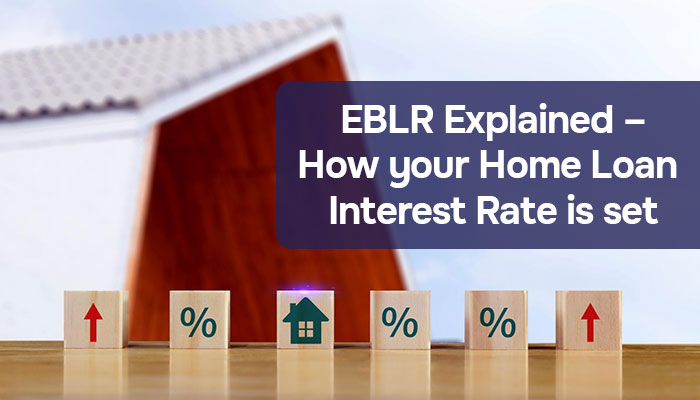
What is EBLR (External Benchmark Lending Rate) in Home Loan?



October 27, 2025
1 min
If you have been exploring home loans recently, you may have come across the term EBLR (External Benchmark Lending Rate). It plays a crucial role in determining the home loan interest rates you pay and, ultimately, the size of your EMIs. Yet, many first-time homebuyers are unaware of what EBLR means and how it impacts home loan eligibility and affordability.
In this article, we will break down the EBLR full form, explain how the external benchmark lending rate works, and demonstrate its impact on your borrowing costs. This will help you make informed choices while applying for your next home loan.
Understanding EBLR: Full Form & Meaning
The EBLR full form is External Benchmark Lending Rate. Simply put, it is the reference rate used by financial institutions to set the interest rates on floating-rate home loans.
Before EBLR, many banks used the Marginal Cost of Funds-based Lending Rate (MCLR) as their internal benchmark. MCLR itself was an improvement over older base-rate systems, but it was still internally computed.
MCLR was built from components such as:
- The marginal cost of funds for the bank
- The negative carry-on reserve requirements
- Operating costs
- A tenor premium
Because MCLR relied on a bank’s internal funding costs and periodic review cycles, changes in policy rates did not always pass through to customer loans quickly.
Why was the External Benchmark Lending Rate Introduced?
Unlike earlier regimes (like MCLR or Base Rate), EBLR is linked to an external benchmark — typically the RBI’s repo rate — which means it moves in sync with changes made by the Reserve Bank of India.
The key advantages are:
- Transparency: You can view the external number the lender uses.
- Faster transmission: When the benchmark moves, your loan rate adjusts more quickly than under older systems.
- Easier comparison: You can compare offers more easily because the base is public, not an opaque internal calculation.
How EBLR Works for Home Loans
When you apply for a floating-rate home loan, the lender calculates your final interest rate as:
Home Loan Interest Rate = EBLR + Spread/Markup
- EBLR: The external benchmark rate, such as the RBI repo rate
- Spread/Markup: The margin added by the lender, based on your credit profile, loan amount, and risk category
This means that if the RBI increases the repo rate, your EBLR also increases, and consequently, your home loan interest rate rises. Similarly, when the repo rate falls, your interest rate and EMIs also reduce.
Imagine you take a ₹15 lakh home loan for 15 years at an EBLR of 6.5% plus a spread of 2%. Your effective interest rate becomes 8.5%.
If the RBI reduces the repo rate by 0.5%, your EBLR drops to 6%, and your new rate becomes 8%. This reduces your EMI, helping you save on interest over the long term.
Also Read: What Are Floating Interest Rates? Benefits, Risks & More
To better understand how a change in the EBLR affects your monthly outgo, you can also use a Home Loan EMI Calculator . It helps you instantly see how a small change in rates impacts your EMI and total repayment, making your financial planning easier.
Tips to manage your EBLR-Linked Loan
Before choosing an EBLR rate home loan, here are some smart strategies to manage it effectively:
- Check the Spread: Compare spreads across lenders as they remain fixed for the loan tenure.
- Improve Your Credit Score: A higher loan credit score can help you get a lower spread.
- Plan for Rate Hikes: Keep an emergency fund to absorb temporary EMI spikes.
- Use an EMI Calculator: Experiment with different interest rates to know how EMI changes.
Also Check: IIFL Home Loan EMI Calculator
Final Word
If you prefer quicker benefits from rate cuts, an EBLR-linked loan is generally better. However, if EBLR increases, expect your EMI to rise unless you switch to a fixed plan or prepay. When comparing lenders, don’t just look at the headline EBLR. Check the spread you would be charged and any other charges that affect the effective cost.
IIFL Home Loans offers EBLR-linked home loans with competitive spreads, ensuring fair pricing and transparency. Whether you are buying your first home or planning a home renovation, you can explore options that fit your budget and manage your EMIs with ease.
Tags

Most Read Blogs




Frequently Asked Questions (FAQ’s)
Q1. What is the EBLR full form?
Ans:
EBLR stands for External Benchmark Lending Rate. It is the reference rate that lenders use to calculate interest rates on floating-rate home loans.
Q2. How does EBLR affect my home loan EMI?
Ans:
Since EBLR is linked to the RBI repo rate, your EMI will go up or down whenever the repo rate changes, making it more transparent and market-driven.
Q3. Is EBLR better than MCLR?
Ans:
Yes, EBLR provides faster transmission of rate cuts and hikes, making it fairer for borrowers compared to MCLR, where changes took longer to reflect.
Q4. Can I switch my old home loan to EBLR?
Ans:
Yes, most lenders allow you to switch from MCLR/Base Rate to an EBLR-linked loan, usually with a small conversion fee.
Q5. How can I get the best EBLR-linked loan?
Ans:
Maintain a good credit score, compare spreads across lenders, and choose a trusted NBFC like IIFL Home Loans for transparent pricing and quick approval.
What can we help you with?

Home Loan

Secured Business Loan

Balance Transfer

Home Improvement Loan

Home Loan for Uniformed Services

NRI Home Loan
Home Loan
Secured Business Loan
Balance Transfer
Home Improvement Loan
Home Loan for Uniformed Services
Get instant support with existing loan related queries

Raise a Request Get instant access to your existing Loan Account with us Raise a Ticket 

Call Helpline Speak with our Customer Support Executive on 1860 267 3000

Visit Nearby Branch You can walk into any of our 300+ branches, spanning across 18 states Get Directions
Our Brands & Subsidiaries


Insurance Partners


HDFC Life Insurance
Learn more
Bajaj Life Insurance
Learn more
ICICI Prudential Life Insurance
Learn more
Go Digit General Insurance
Learn more
Aditya Birla Capital Insurance
Learn more
Bajaj Allianz General Insurance
Learn more


