 Login
Login


 Products


 Go Back to blog listing page
What is HRA (House Rent Allowance), and How is HRA Exemption Calculated?



November 14, 2025
1 min
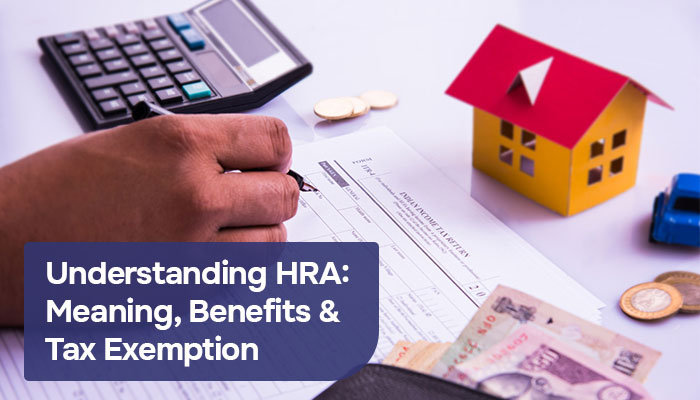
If you’re a salaried individual paying rent, you may have heard of HRA. But do you fully understand what HRA is and how it impacts your tax liability? The good news is that knowing the ins and outs of HRA can help you optimise your tax savings. You’ll learn what HRA means, how the HRA calculation for tax exemption works, and why the choice between old and new tax regimes matters. Let’s walk through this together in simple terms.
What is HRA?
House Rent Allowance (HRA) is a component of your salary provided by your employer to help you meet the cost of renting residential accommodation. It is meant to support living in a rented home and, in many cases, qualifies for exemption from tax under Section 10(13A) of the Income Tax Act.
However, it’s vital to understand that HRA is only part of your salary structure, not over and above it. Moreover, whether you will benefit depends on your salary breakdown, the rent you pay, and where you live.
How HRA Exemption Works: The Key Rules
To properly claim the exemption, you need to follow the rules and execute the HRA calculation for tax exemption yourself.
- To claim HRA deduction under Section 10(13A), you must be a salaried employee, receiving HRA from your employer, and paying rent for residential accommodation.
- You must file under the old tax regime to claim the HRA exemption. If you opt for the new tax regime under Section 115BAC, HRA exemption is not available.
- The exempt amount is calculated as the lowest of the following three values:
- Actual HRA received from your employer.
- 50% of your Basic + Dearness Allowance (DA) if you live in a metro city (Delhi, Mumbai, Chennai, Kolkata) or 40% if you live in a non-metro city.
- Actual rent paid minus 10% of your Basic + DA.
Example to Calculate HRA Deduction
Let’s walk through how you might calculate HRA deduction in practice:
Suppose you live in Delhi (metro city) and your salary breakdown is:
- Basic salary: ₹60,000/month
- Dearness Allowance (DA): ₹10,000/month
- Annual HRA received: ₹25,000/month = ₹3,00,000 per year
- Rent you pay: ₹30,000/month = ₹3,60,000 per year
Now compute:
- Actual HRA received = ₹3,00,000
- 50% of Basic+DA = 50% × (₹60,000+₹10,000) × 12 = ₹3,60,000
- Rent paid minus 10% of Basic+DA = ₹3,60,000 – (10% of ₹70,000 ×12 = ₹84,000) = ₹2,76,000
The lowest of these three values is ₹2,76,000; that is your exempt HRA amount. The rest of your HRA will be added to your taxable income.
Also Read: Home Loan Vs HRA: Which one allows you to Save more Tax?
What Happens Under the New Tax Regime?
One of the most important things to realize is that, under the new tax regime (Section 115BAC), you cannot claim HRA exemption. In other words, the entire HRA component becomes taxable if you choose the new regime.
That means the benefit of HRA deduction is only available if you opt for the old regime, where you get many other deduction options as well, such as Section 80C, 80D, etc. However, the tax slabs and exemptions are different. So, when you’re evaluating your tax choice, ask yourself: “Does the benefit of HRA exemption outweigh the other benefits I might lose?”
Also read: Can HRA be Claimed Together With Interest on Home Loan?
Practical Tips to Maximise Your HRA Benefit
Here are ways to make the most of your HRA deduction (assuming you favour the old tax regime):
- Ensure your employer’s salary structure shows the HRA component clearly.
- Keep valid rent receipts, signed by your landlord. If rent exceeds ₹1 lakh in a year, your landlord’s PAN must be furnished.
- If you pay rent to your parents (or relatives), ensure you have a rental agreement and proof of payment.
- Before filing your ITR, compare tax outcomes under the old regime (with HRA) vs the new regime (without HRA) and pick what works best for you.
- Even though you don’t always submit rental receipts with ITR, maintain them meticulously because the tax department may verify.
Why Knowing What HRA Matters to You
Understanding what HRA is and how HRA calculation for tax exemption works empowers you to make better decisions about your salary, living arrangements and tax planning. It’s about being aware, rather than just being given a salary and accepting it at face value.
Remember: since the new tax regime removes this benefit altogether, the decision between old vs new becomes even more significant. Your tax outcome, living costs and renting decisions all become tied together.
Tags

Most Read Blogs




Frequently Asked Questions (FAQ’s)
Q1. Can I claim HRA deduction if I live with my parents and don’t pay rent?
Ans:
No. To claim HRA deduction, you must pay rent to a landlord and have rent receipts. If you’re not paying rent or the owner is your immediate relative without documented rent, you won’t qualify under Section 10(13A).
Q2. How much HRA deduction can I claim if I’m in a non-metro city?
Ans:
In a non-metro city, one of the criteria is 40% of your Basic + DA, and you also compute the other two values (actual HRA and rent-paid minus 10% salary). The minimum of the three becomes your exempt amount.
Q3. If I opt for the new tax regime, does that mean HRA is completely useless?
Ans:
While HRA still helps you cover living rent costs, under the new tax regime, you cannot claim HRA exemption, and the full amount will be added to your taxable income.
Q4. Can I claim HRA if I own a house but still pay rent elsewhere?
Ans:
Yes, if you legitimately pay rent and receive HRA from your employer, you may claim the exemption under the old tax regime. The key is living in rented accommodation and paying rent for it.
Q5. What documents do I need to claim HRA deduction?
Ans:
Maintain rent receipts (with landlord’s name, address, amount & period covered). If annual rent exceeds ₹1 lakh, the landlord’s PAN must be included. Also retain the rental agreement, bank proof of payment and salary slip showing the HRA component.
What can we help you with?

Home Loan

Secured Business Loan

Balance Transfer

Home Improvement Loan

Home Loan for Uniformed Services

NRI Home Loan
Home Loan
Secured Business Loan
Balance Transfer
Home Improvement Loan
Home Loan for Uniformed Services
Get instant support with existing loan related queries

Raise a Request Get instant access to your existing Loan Account with us Raise a Ticket 

Call Helpline Speak with our Customer Support Executive on 1860 267 3000

Visit Nearby Branch You can walk into any of our 300+ branches, spanning across 18 states Get Directions
Our Brands & Subsidiaries


Insurance Partners


HDFC Life Insurance
Learn more
Bajaj Life Insurance
Learn more
ICICI Prudential Life Insurance
Learn more
Go Digit General Insurance
Learn more
Aditya Birla Capital Insurance
Learn more
Bajaj Allianz General Insurance
Learn more


