 Login
Login


 Products


 Go Back to blog listing page
MSME Loan Eligibility: Impact of GST Reforms



November 14, 2025
1 min
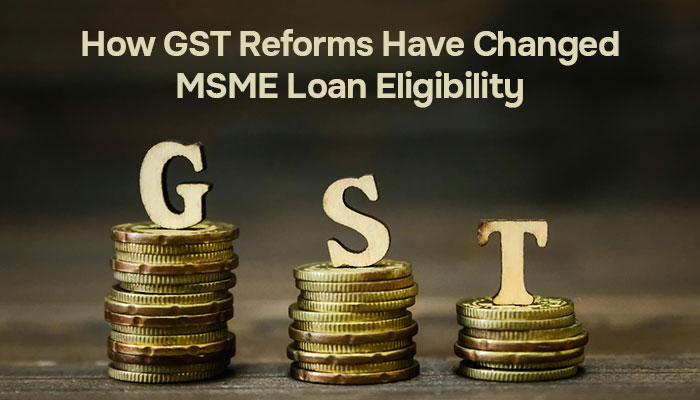
If you run a small or medium enterprise, you know how much documents, taxes, and invoices matter when applying for a business loan. Recent GST reforms don’t just affect your cost structure but can also influence MSME loan eligibility.
In this article, you’ll understand the impact of GST on small business financing, see what changes help you meet eligibility criteria, and find out how to make your application stronger, especially considering new GST rationalisation and simpler tax rules.
What Are the Key GST Reforms You Should Know
Here are the recent changes under the GST 2.0 framework and related reforms that directly affect MSMEs:
- Rationalised GST slabs: Many products and raw materials have moved from higher GST rates (like 28% or 12%) down to 18% or 5%. This reduces input cost for MSMEs and improves margins.
- Easier Input Tax Credit (ITC): Simplification helps ensure more reliable and faster ITC refunds. This improves working capital and cash flow.
- Reduced compliance burden: Fewer tax slabs, more predictability in rates, and streamlined procedures reduce frequent audits/confusion. For small businesses, that means fewer surprises in tax liabilities.
- Stronger formalization: More MSMEs are coming under formal GST regimes due to lower thresholds and easier registration. This helps them build a credit history which lenders positive view.
How GST Reforms Impact MSME Loan Eligibility
The changes above tie directly into how lenders assess MSME loan eligibility. Here’s how:
Better Profitability & Margins
Lower taxes on inputs and simpler rates mean your cost of production drops. That can lead to higher margins, which improve your business financials — a key factor lender look at.
Improved Cash Flow
Faster ITC refunds mean you aren’t waiting months for tax credits. More liquid cash helps you pay EMIs, service debt, and reduces risk in the lender’s eyes.
Cleaner Books & Compliance
With simpler GST compliance, fewer errors, and fewer penalties, your financial statements become more stable and reliable. Lenders like that when evaluating MSME loan eligibility.
Stronger Track Record Under GST
Being compliant under GST gives you proof of formalised business operations. Lenders often demand consistent turnover, GST filings, etc. These reforms help more MSMEs satisfy those criteria.
Practical Insights: What MSMEs Should Do Before Applying
To take full advantage of the impact of GST reforms on your MSME loan eligibility, these are some actionable steps you can take today:
- Maintain clean and regular GST filings. Even small delays or mismatches can lower the lender's confidence.
- Keep records of input purchases and ensure you claim ITC properly. The less you lag in documentation, the better your financials look.
- Check your turnover classification. With changes in thresholds, you might now qualify in a higher bracket, this could allow larger loans.
- Forecast cash flows with the revised GST slab rates. Lower tax outgo on inputs can improve profit forecasts that you show to lenders.
- Choose lenders who understand GST 2.0 and are open to MSMEs, NBFCs like IIFL Home Loans or small business-focused sections of banks often have more flexible criteria.
Example: GST Reforms Helping a Small Manufacturer
To illustrate:
- Suppose you are a small furniture manufacturer. Earlier, many wooden components, polishing chemicals, and finishing materials were taxed at 18% or higher. Under the new GST reform, certain sub-items move down to 5%.
- Your input cost falls by, say, 8-10%.
- This improves your annual profit by some thousands (or more, depending on scale), and improves your EBITDA.
- When you apply for a loan now, your profit-to-loan repayment ratio looks healthier; cash flow is more stable due to faster ITC refunds. That helps you meet MSME loan eligibility criteria more easily.
Considerations & Things You Should Be Mindful Of
While GST reforms are beneficial, some aspects still require attention:
- Even with simpler slabs, documentation (invoices, reconciliations) must be accurate. Mistakes still cause delays.
- Refund delays may still happen depending on state enforcement or backlog. This can affect liquidity.
- Not all sectors benefit equally. Some items remain in higher slabs; some reforms may phase in later.
Using GST Reforms to Your Benefit
In summary, the recent GST reforms are much more than tax changes. They have real power to improve MSME loan eligibility through cleaner financials, better margins, and more formal status. As an MSME owner, understanding these reforms and organising your business around them can open doors to better loan amounts, favorable rates, and smoother approvals.
If you want to explore small business financing options that align with the new GST environment, check out relevant MSME loan offerings, compare lender criteria, and prepare robust documentation. With informed planning, you can make the impact of GST on small business work in your favour.
Tags

Most Read Blogs
Loan Against Property




Frequently Asked Questions (FAQ’s)
Q1. How does GST rate rationalisation affect my ability to get a business loan?
Ans:
When rates on inputs drop, your cost of goods sold goes down. That increases your profit margins, which lenders look at while assessing debt service capacity. Improved margins often mean you can show stronger financials, raising your loan eligibility.
Q2. Does simplified GST compliance increase loan eligibility for micro units?
Ans:
Yes. Simplified slabs, fewer paperwork requirements, and improved refund systems reduce risk for lenders. Businesses with cleaner GST records are seen as less risky and more eligible for MSME loans.
Q3. Will the GS T reforms reduce interest rates on MSME loans?
Ans:
Not immediately, the interest rates depend on many factors. But improved cash flow and reduced cost pressure can help you negotiate better terms or get access to lenders with lower risk thresholds.
Q4. What minimum documents do I need now for MSME loan eligibility considering GST changes?
Ans:
At minimum: latest GST returns, proof of regular input purchases, audited or unaudited financials showing improved margins, turnover certificates aligning with new MSME classification, bank statements showing receipts after claim of ITC.
Q5. Can these GST reforms help informal businesses become eligible for MSME loans?
Ans:
Potentially yes. As more MSMEs formalise under GST (because threshold limits increase, registration becomes simpler), these businesses can build a verifiable GST history. That helps them approach lenders with better credentials for loan eligibility.
What can we help you with?

Home Loan

Secured Business Loan

Balance Transfer

Home Improvement Loan

Home Loan for Uniformed Services

NRI Home Loan
Home Loan
Secured Business Loan
Balance Transfer
Home Improvement Loan
Home Loan for Uniformed Services
Get instant support with existing loan related queries

Raise a Request Get instant access to your existing Loan Account with us Raise a Ticket 

Call Helpline Speak with our Customer Support Executive on 1860 267 3000

Visit Nearby Branch You can walk into any of our 300+ branches, spanning across 18 states Get Directions
Our Brands & Subsidiaries


Insurance Partners


HDFC Life Insurance
Learn more
Bajaj Life Insurance
Learn more
ICICI Prudential Life Insurance
Learn more
Go Digit General Insurance
Learn more
Aditya Birla Capital Insurance
Learn more
Bajaj Allianz General Insurance
Learn more


